Back Up Home Generators Portable and Standby: A Homeowner Guide
Puyallup · Community Photo
Keep essential appliances powered when severe weather or grid outages strike. Compare portable and standby options by upfront expense, power needs, fuel logistics, and safe operation to choose the right fit for your home.
Back up home generators portable and standby: making the right choice
Compare Portable and Standby Generators Side by Side
Comparison point | Portable generator | Standby generator |
|---|---|---|
Upfront expenses | Unit purchase, plus any cords, accessories, and equipment for connecting to household circuits. | Unit purchase plus professional setup, ATS, mounting pad, fuel-line work, and permits. |
Power output | Generally 1–12 kW; designed to supply selected essential appliances and individual plug-in devices. | Typically 10–26 kW or more for residential use; can supply an entire home when sized for its loads. |
Fuel supply | Primarily gasoline; some models also support propane or natural gas. Stored-fuel operation requires fuel management and manual refueling. | Connected to a natural gas line or an on-site fuel tank. Operation depends on the continued availability of fuel. |
Switching arrangements | Manual switching equipment or a generator interlock for household circuits; suitable heavy-duty extension cords for individual devices. | ATS detects utility power loss and switches the home's supply automatically. |
Starting method | Manual pull-cord or electric start; someone must be present to operate the unit outdoors. | Starts automatically after utility power fails, even when occupants are away. |
Maintenance | Regular engine care, including oil changes, spark plug checks, and gasoline storage or carburetor management. | Periodic servicing and automated self-test cycles. |
Setup requirements | Basic operation with extension cords does not require professional installation. Connection to household circuits requires a licensed electrician. | Permanent professional installation involving a mounting pad, fuel plumbing, electrical wiring, ATS, and local permits. |
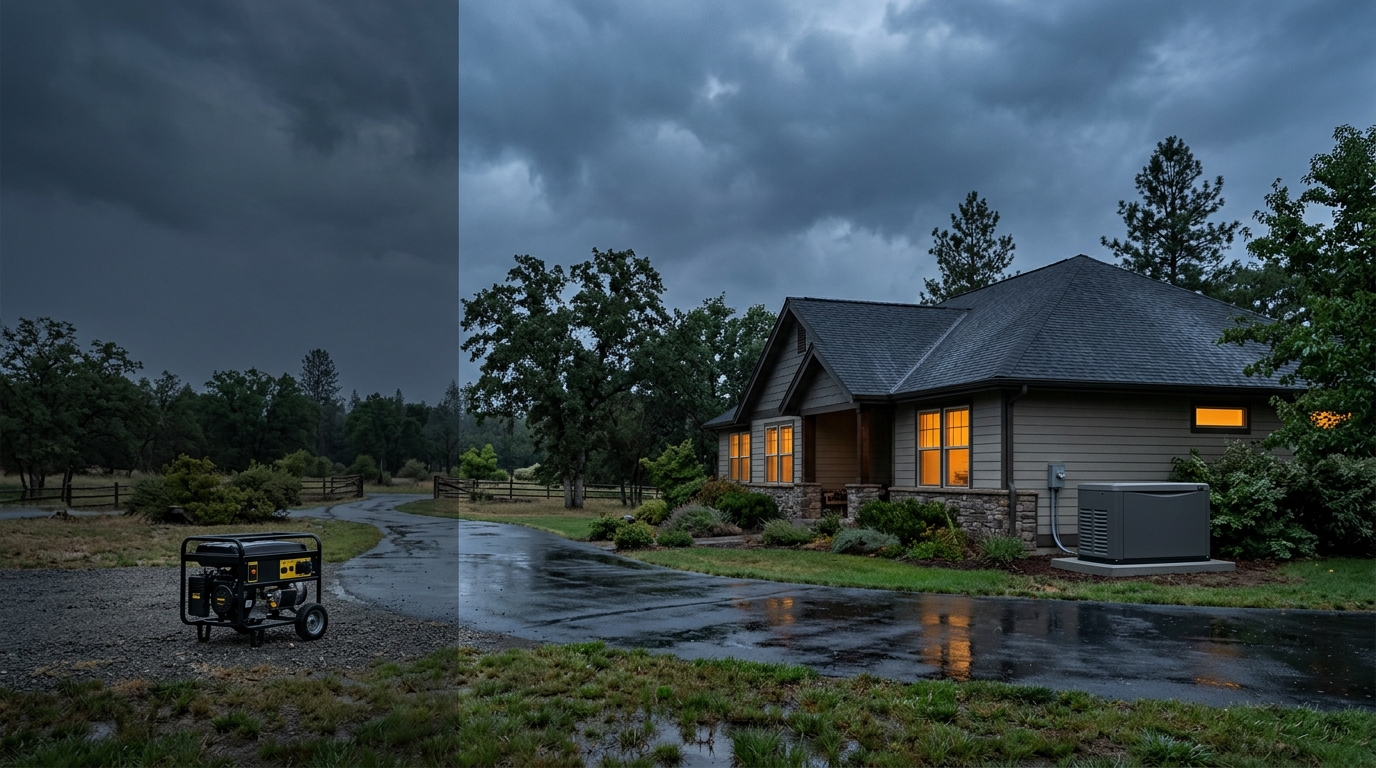
The main trade-off is upfront savings versus hands-free operation.A portable unit suits a tighter budget and selected essential appliances, but someone must set it up outdoors, start it, and manage its fuel. Include connection equipment and any electrical work in your budget—not just the unit purchase.
A standby system requires a larger upfront commitment and permanent professional installation. In return, it starts and switches the home's supply automatically when utility power fails, including while occupants are away. A connected fuel supply reduces manual handling, although operation still depends on fuel availability and routine servicing.
Choose around the loads you need and the work you can manage.Match generator capacity to the appliances you intend to operate rather than assuming either option will power everything. If you can handle setup and refueling, a portable unit may meet your needs. If unattended operation matters more, a standby system offers automation at a higher initial expense.
How Portable Generators Work: Setup and Safety
Conventional vs Inverter Generators: How They Produce Power
Conventionalportable generatorsrely on a gasoline‑driven internal‑combustion engine that directly drives a mechanical alternator. The engine maintains a constant speed—usually 3,600 rpm for a 60 Hz output—so the alternator produces a steady AC voltage.
Because the engine speed is fixed, the unit runs at essentially the same throttle regardless of how much electricity is being drawn. This fixed‑speed operation often leads to louder noise and greater fuel consumption at light loads when compared with demand‑responsive inverter designs that can adjust engine speed to match the load.
The alternator’s output follows a sinusoidal pattern, but the mechanical nature of the system can introduce slight waveform distortion, such as added harmonic content. Most appliances function normally, though some sensitive equipment may notice the less‑pure wave shape. These conventional units are a common choice forportable home power backup.
Inverter Conversion Sequence
Comparison Parameter | Conventional Design | Inverter Design |
|---|---|---|
Electricity Generation Method | Directly produces alternating current (AC) via an engine-driven alternator. | Generates high-frequency AC power, converts it to direct current (DC), and then inverts it back into clean AC power. |
Engine-Speed Behavior | Operates at a constant, fixed speed regardless of the connected electrical load to maintain required frequency. | Automatically varies and adjusts engine speed dynamically based on real-time power demand. |
Noise Under Lighter Loads | Maintains high noise levels continuously because the engine runs at full fixed speed even under minimal loads. | Operates significantly quieter under lighter loads as the engine slows down to match the reduced demand. |
Light-Load Fuel Use | Consumes higher amounts of fuel inefficiently because the engine continues running at maximum constant speed during low-demand periods. | Reduces fuel consumption significantly under light loads due to variable engine-speed adaptation. |
Power Quality for Sensitive Electronics | Produces raw, unregulated power with potential voltage fluctuations and electrical noise that can pose risks to sensitive digital devices. | Delivers clean, stable, and smooth electrical output with minimal harmonic distortion, ensuring safety for sensitive electronics. |
Portability | Generally heavier, bulkier, and built on open frames, making them harder to transport and move. | Typically lighter, more compact, and often housed in enclosed, sound-insulated casings designed for easy carrying. |
Choosing stored fuels or a natural gas supply
Dual-fueldesigns are engineered to accept either gasoline or liquid propane as an energy source.
Gasolinegenerally provides a higher peak output, which is useful for running demanding appliances for short periods.
Propaneburns cleaner and, because it does not degrade over time, is suitable for extended storage without causing fuel degradation or carburetor deposits.
Having both fuel options offers flexibility when supplies are disrupted; the operator can choose the available fuel and manually switch the unit, though the change is not automatic.
Tri‑fuel generator flexibility
Feature / Dimension | Dual-Fuel Options | Tri-Fuel Options |
|---|---|---|
Supported Fuels | Supports gasoline and liquid propane (LP). | Supports gasoline, liquid propane (LP), and natural gas (NG). |
Stored-Fuel Logistics | Requires physical storage and management of portable fuel sources (gasoline cans and/or propane tanks), which have finite volumes and require manual refilling or swapping. | Relies on stored fuel (gasoline and propane) for portable or backup flexibility, with the added capability to bypass stored fuel entirely via utility lines. |
Access to a Connected Natural Gas Supply | Does not utilize a connected utility natural gas supply natively. | Features a connection setup (such as a factory-installed inlet or kit compatibility) to tap directly into a continuous, piped municipal or residential natural gas utility supply. |
Output Trade-offs | Typically yields peak electrical output when operating on gasoline, with lower energy density and slightly reduced wattage output when running on propane. | Yields maximum output on gasoline, experiences a decrease on propane, and typically incurs the lowest peak wattage and energy output when running on natural gas due to its lower energy density. |
Choosing Safe Circuits and Isolating Generator Power
What is Backfeeding?
Selected‑Circuit Transfer Arrangement
What an Interlock Kit Is
Feature / Design Aspect | Selected-Circuit Transfer Switch Design | Interlock Kit |
|---|---|---|
Equipment Layout | Utilizes a separate subpanel box containing pre‑wired toggle switches or buttons alongside a dedicated set of circuit connections. | Installs directly onto the existing main electrical load center using a mechanical sliding metal plate that governs breaker access. |
Circuit Selection | Restrictive; limited strictly to a pre‑chosen fixed number of specific circuits (e.g., 6, 8, or 10 circuits) hardwired during setup. | Flexible; permits access to any individual circuit in the main panel up to the total capacity limits of the portable generator. |
Manual Operation | Performed by flipping individual toggle or rotary switches corresponding to the designated backup circuits from utility to generator power. | Performed by manually sliding a safety plate to turn off the main utility breaker, sliding the plate, and switching on the designated generator back‑fed breaker. |
Load‑Management Responsibility | Low; load distribution is pre‑selected and limited by the hardware design, reducing the likelihood of inadvertently overloading the generator. | High; the user must manually calculate and monitor power usage across active circuits to prevent exceeding the generator's capacity. |
Panel Compatibility | Universal/Independent; generally mounts next to any main load center as an independent subassembly regardless of the main panel brand. | Panel‑Dependent; requires a specific listed kit engineered to match the exact brand, model configuration, and spacing of the existing main breaker panel. |
An interlock kit often provides a budget advantage because it uses the home's existing electrical panel and breakers, reducing hardware costs and labor compared with installing a separate subpanel and dedicated switching hardware. |
Do Not Plug a Generator Into a Wall Outlet
Connecting a generator directly to a standard household receptacle creates a backfeed condition that can endanger utility workers, cause fire hazards, and damage equipment.
Use a Licensed Electrician for Safe Installation
Only a qualified, licensed electrician should install the proper transfer equipment or an approved interlock kit to link the generator to your home’s wiring and prevent backfeeding.
Critical Generator Safety Warnings
Generator exhaust contains carbon monoxide, a deadly gas you cannot see or smell. Never run a generator inside a home, garage, shed, or other enclosed space—even with doors or windows open or fans running.
Operate the unit outdoors at least 20 feet from homes, garages, sheds, and enclosed spaces. Point the exhaust away from doors, windows, vents, and crawlspaces. A covered patio too close to a building is not a safe alternative.
Never plug a generator into a household wall outlet. Backfeeding can send electricity into utility lines and endanger line workers. Have a licensed electrician install an appropriate transfer switch or panel-compatible interlock kit before connecting the generator to household wiring.
Standby Generators: Automatic, Permanently Installed Power
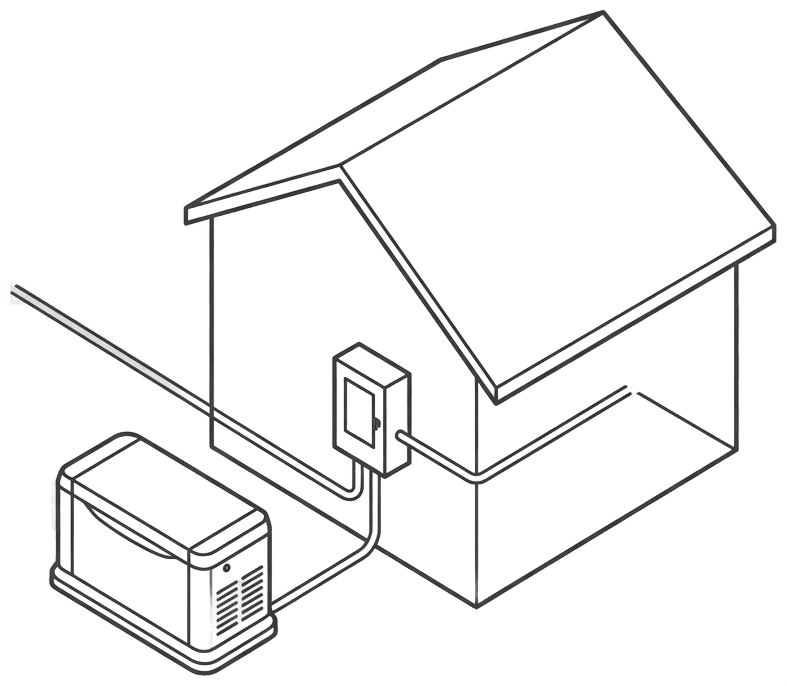
A permanently installed standby system is designed to restore electricity automatically when utility service fails. Unlike equipment that must be positioned and connected during an outage, it remains connected to the home’s electrical system through professionally installed transfer equipment.
Automatic operation and safe switching.An automatic transfer switch (ATS) monitors utility power and initiates the changeover to generator power after an outage. It isolates the home from the utility supply, helping prevent dangerous backfeeding. When utility service returns, the system transfers the home back. Automatic operation reduces hands-on setup, but it does not mean electricity remains uninterrupted during the changeover.
Permanent fuel connections.Standby units commonly use natural gas or propane supplied through a fixed fuel line, avoiding gasoline cans and extension cords. Natural gas connects to the household supply, while propane depends on the fuel available in a storage tank. Neither arrangement should be treated as a guarantee of unlimited operation: fuel availability and ongoing maintenance still matter.
Whole-house coverage requires careful sizing.A whole-house generator must be matched to the appliances and circuits you want to support, including equipment that needs extra power when it starts. Whole-house capability does not automatically mean every appliance can operate simultaneously. Have the installer evaluate your intended loads and explain whether load management is needed to prioritize essential equipment.
Professional installation and ownership costs.Installation involves coordinating electrical connections, transfer equipment, fuel-line work and outdoor placement. Ask for an itemized installation cost that distinguishes the equipment from site preparation and connection work. Compare the complete ownership commitment—including fuel, maintenance and servicing—rather than judging the system by its purchase price alone.
Monitoring and maintenance.When evaluating remote monitoring, ask whether the proposed system supports off-site status checks, fault notifications or maintenance alerts, and whether connectivity or additional services are required. Treat monitoring as a convenience, not a substitute for inspections and scheduled servicing. The practical advantage of standby power is automatic response with less manual intervention; reliable protection still depends on appropriate sizing, safe installation and continued upkeep.
From Utility Outage to Automatic Restoration
A coordinated sequence brings generator power to your home—and switches back when utility power returns.
Outage detection
The automatic transfer switch senses utility power loss in milliseconds.
A brief delay helps prevent temporary flickers from triggering an engine start.
Engine startup
The generator starts automatically and stabilizes its speed, voltage and frequency.
Safe grid disconnection
Transfer equipment isolates the home from the utility supply before connecting generator power, helping prevent backfeeding.
Whole-home restoration
A properly sized system supplies the home’s planned loads automatically.
Whole-home coverage depends on system sizing and load management.
Sizing Your Generator: Starting vs. Running Watts
Home backup power • planning tool
Generator wattage calculator
Build a simultaneous load, then compare continuous demand and startup allowance.
Add appliances
Select a card for each separate entry. All added devices are included initially.
Your appliance list
Generator FAQs: Selection, Maintenance & Codes
A permanent standby installation typically requires electrical permitting for the transfer equipment and panel connection. A gas connection may also require a plumbing or gas permit. Ask your installer to confirm local requirements before work begins.
If your property belongs to an HOA, review its approval process before choosing a location. Placement, visibility, screening, setbacks and noise can affect approval. Be prepared to submit manufacturer specifications and a site layout. Legal protections vary by jurisdiction, so do not assume that rules from another area apply to your home.
Gasoline deteriorates in storage, and stabilizer can help extend its usable life. Follow the fuel and generator manufacturers' storage instructions, keep containers properly sealed and rotate stored supplies rather than relying on old fuel during an outage.
Diesel can also deteriorate through oxidation, water contamination and microbial growth. Propane does not degrade like gasoline or diesel, but safe storage depends on sound tanks and valves. A utility natural gas connection avoids storing fuel on-site.
Inverter generators convert their electrical output into DC and then back into stable AC power with a pure sine wave. This makes them a useful choice for sensitive electronics such as computers and smart TVs.
Conventional models can produce electrical noise or harmonic distortion. Check the generator's output specifications against your devices' requirements rather than choosing on power output alone. For medical equipment, confirm compatibility with the equipment manufacturer before relying on a generator.
Most standby units need professional servicing at least once per year or every 200 operating hours. Follow your model's maintenance schedule, including any initial oil-change requirements and additional service needed after extended operation.
Routine maintenance includes oil and filter changes according to the owner's manual. Keep a record of operating hours and completed service. Automated exercise cycles help check startup readiness, but they do not replace scheduled maintenance.